Tuesday, February 27, 2007
A Thing As Big As The Ocean
Disclexington artists Joe Cashiola and Jeff Harms, who recorded here with Hotel Brotherhood, are back from the bottom half of the States, shooting their new feature-length movie. The trailer is up on Robot Machine Gun. Check it out.

Thursday, February 15, 2007
Urban, Lost Cowboy
 Hey folks, introduce yourself to Urban Djin, a south side yodeler with a vast repertoire of American music from Western Swing and Honky Tonks to Latin boleros and polkas. He's been writing up a storm on his myspace blog about the old Maxwell Street Scene, the state of country music today and other stuff. Urban's playing these days every Thursday night at the Smoke Daddy in the Ukrainian Village and as usual on Sundays at the Maxwell Street Flea Market. And of course Urban is featured on the new Disclexington release, Ed, which you should get because it won't cost you an arm and a leg, and because it is good.
Thursday, February 08, 2007
Interview with Gapers Block is up.
Wednesday, February 07, 2007
Hey Kids - Mi Barrio
I talk about my neighborhood on the NAP, where this week you can also get in on a heated debate about New Orleans and Iraq, or get inside John Cramer's dark brain, or learn that Doug wants to play cello, or listen to some knuckle scraping ROCK, or get mad enough at MT to tickle him.
Tomorrow check out Gapers Block. I got myself interviewed in the Air Bags section by John Hospodka, the resident art interviewer. His section is called "Three Questions for..."
Tomorrow check out Gapers Block. I got myself interviewed in the Air Bags section by John Hospodka, the resident art interviewer. His section is called "Three Questions for..."
Friday, January 26, 2007
Hey Houston - Free Beer. Be an extra. Meet some cool peeps
Some friends are filming in H-town this weekend. Here, let me let them tell you...
Hanger-outers is what we want. Not a bunch of actors pretending to hang out. And you would be suprised what we can do with just 3 people with today's digital technology, you could become an army of hanger-outers.
So, please come! Come one, come three! Come all!
We are shooting on February 29th 3pm-6ish at the Proletariat
And we will be filming the night of the benefit at the Proletariat too (Sunday the 28th), so you should come out and support that too.
Extras will be drinking real beer, provided by Four Birds Pictures. so that's a free happy hour(s).
Sincere thanks for your replies.
jeff
Hanger-outers is what we want. Not a bunch of actors pretending to hang out. And you would be suprised what we can do with just 3 people with today's digital technology, you could become an army of hanger-outers.
So, please come! Come one, come three! Come all!
We are shooting on February 29th 3pm-6ish at the Proletariat
And we will be filming the night of the benefit at the Proletariat too (Sunday the 28th), so you should come out and support that too.
Extras will be drinking real beer, provided by Four Birds Pictures. so that's a free happy hour(s).
Sincere thanks for your replies.
jeff
Thursday, January 25, 2007

Saturday, January 20, 2007
another bonus song from the new Disclexington compilation
This special listen goes out to you bloggettes and you only thanks for reading.
broadtosser-gunshow.mp3
From our Nonalignment Pact post -
 A decidedly all-girl rock band who are hot and rock and they would like you to recognize that little fact. BroadTosser sounds like the Throwing Muses throwing down with Black Sabbath. Recently they've been recording a new demo as a three piece with lots of tricky studio stuff on it. When they recorded for Disclexington they were still a four piece. I like their new direction but I am also deeply satisfied with the pureness of Sarah's voice captured only on the Ed release.
P.S. Get you a copy of the Disclexington compilation here. The price is right (8 bucks including shipping!). This price may go away as distribution is ironed out so hurry. :- )
broadtosser-gunshow.mp3
From our Nonalignment Pact post -
 A decidedly all-girl rock band who are hot and rock and they would like you to recognize that little fact. BroadTosser sounds like the Throwing Muses throwing down with Black Sabbath. Recently they've been recording a new demo as a three piece with lots of tricky studio stuff on it. When they recorded for Disclexington they were still a four piece. I like their new direction but I am also deeply satisfied with the pureness of Sarah's voice captured only on the Ed release.
P.S. Get you a copy of the Disclexington compilation here. The price is right (8 bucks including shipping!). This price may go away as distribution is ironed out so hurry. :- )
Thursday, January 11, 2007
New from Disclexington: Ed, an 8-Track Compilation

Wednesday, January 10, 2007
Sunday, December 31, 2006


Thursday, December 28, 2006

Friday, December 08, 2006

Wednesday, December 06, 2006
Friday, December 01, 2006
Snow Day
What a way to start December, with inches and inches of fluffy white powder and coffee in bed. Tricia got a Snow Day to boot.
 In other news: Chris Ware is on the cover of the New Yorker in a BIG way. The weekly magazine put out four different covers all by Mr. Ware and there's an online piece called Leftovers and an audio interview, check it out. It was only a matter of time before the New Yorker celebrated Ware's work in this manner what with the mag's Peter Schjeldahl proclaiming Chris Ware's book Jimmy Corrigan: The Smartest Kid on Earth to be the apex of the genre. Mr. Schjeldahl compares Ware's graphics to Belgian comic book artist Hergé who did the TinTin series mid-twentieth century. I was a big TinTin fan growing up and I still own all the TinTin books. The graphic similarities did appeal to me at first but Chris Ware's melancholy stories are nothing like TinTin's fantastical adventures.
*graphic courtesy of Chicago Public Radio
In other news: Chris Ware is on the cover of the New Yorker in a BIG way. The weekly magazine put out four different covers all by Mr. Ware and there's an online piece called Leftovers and an audio interview, check it out. It was only a matter of time before the New Yorker celebrated Ware's work in this manner what with the mag's Peter Schjeldahl proclaiming Chris Ware's book Jimmy Corrigan: The Smartest Kid on Earth to be the apex of the genre. Mr. Schjeldahl compares Ware's graphics to Belgian comic book artist Hergé who did the TinTin series mid-twentieth century. I was a big TinTin fan growing up and I still own all the TinTin books. The graphic similarities did appeal to me at first but Chris Ware's melancholy stories are nothing like TinTin's fantastical adventures.*graphic courtesy of Chicago Public Radio
Wednesday, November 29, 2006
History Lesson
I did my part for humanabees on Nonalignment this week. I have more to say here but I haven't had the time.
Monday, November 20, 2006
Joe Mathlete's Dog and Titty
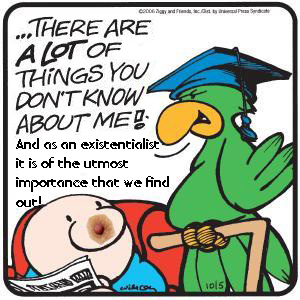
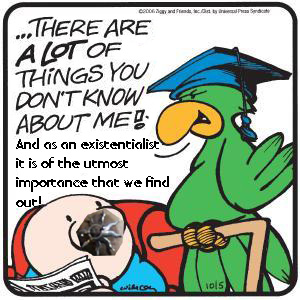
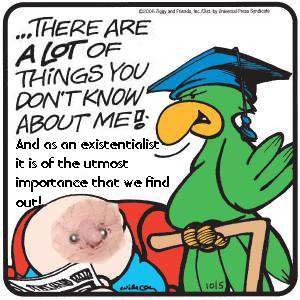
I don't know Joe Mathlete just some of his friends but I stumbled on his sites the other day and they made me laugh. In one he explains "Today's Marmaduke." In another he draws a nipple on Ziggy's nose (this site is apparently discontinued). The critic in me wants to say why not explain Marmaduke a bit more existentially and so get to its paramount importance faster.
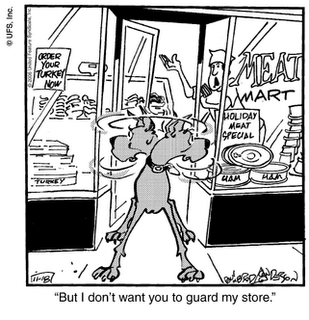 For example...Joe's explanation of this Marmaduke is as follows:
Marmaduke, whose perceptions regarding Meat Mart's importance to the community are skewed at best, is defending the store against potential thieves despite protests from an employee.
Nothing wrong with that but mind you I for one don't believe that Marmaduke is concerned about the community one heck. I'd explain it so:
The gullible butcher, betrayed by positivism once again, confuses Marmaduke's territorialism as guardianship; just as slightly less than half the people of this country view our leader's actions as being in their best interests.
As for drawing a nipple on Ziggy's nose, which I am all for, why not broaden the range a bit? The world is blessed with a wide variety of papilla and accompanying aerola. While Ziggy, an existential stand-in for Jesus, is never changing doth his nipple need share his fate?
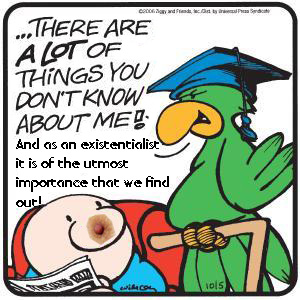
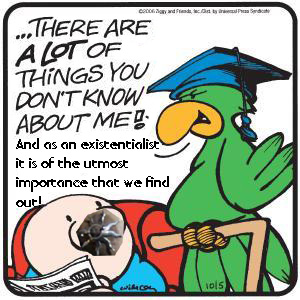
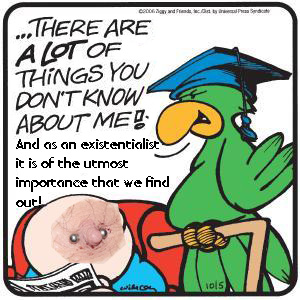
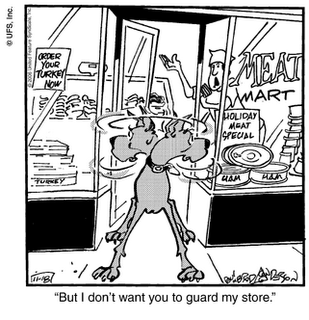 For example...Joe's explanation of this Marmaduke is as follows:
Marmaduke, whose perceptions regarding Meat Mart's importance to the community are skewed at best, is defending the store against potential thieves despite protests from an employee.
Nothing wrong with that but mind you I for one don't believe that Marmaduke is concerned about the community one heck. I'd explain it so:
The gullible butcher, betrayed by positivism once again, confuses Marmaduke's territorialism as guardianship; just as slightly less than half the people of this country view our leader's actions as being in their best interests.
As for drawing a nipple on Ziggy's nose, which I am all for, why not broaden the range a bit? The world is blessed with a wide variety of papilla and accompanying aerola. While Ziggy, an existential stand-in for Jesus, is never changing doth his nipple need share his fate?
New Track du Jour
Artist: Brillo
Track: Whole Heart
Location: Sunken Monastery (Chicago,IL)
Date: 11-20-2006
Comment: Three years ago, two good friends had a baby born with Down Syndrome. It was very sad at first for everybody and scary because the boy was born with a hole in his heart. I was in a depression at the time myself and I usually sit down to write a song when I'm down. I had some familiarity with Down Syndrome though because Tricia's uncle -who is very sweet- also has DS. This is what I wrote and it's sappy ass has never seen the light of day until now. Lyrics follow:
I love your mom and dad
Two kind friends I have
and I want to meet you soon with my whole heart
tender in the things they do
I'm sure they love you too
and you'll want to love them back with your whole heart
your whole heart
I was saddened by the news
strangely not for you
it was for my own heart
still inside
you have the things that others need
kind words from family
and folks around who want the best start for you
I can give you this lullaby
you can have that part of me
you were denied
a hole must not run through it
to be empty inside
just remember this and it's alright
it's alright
Sadly enough, and this needs to be remedied soon, I have never met him.
Wednesday, November 15, 2006
Sunday, November 12, 2006
(Part IV) A Conversation with a Houston Institute: Mark Lacy
It's funny you mention Lewis and Clark. Tricia and I took a trip across the Northwest this Summer and hit on a lot of LC landmarks. I read that at the 100th anniversary Exposition, the advertisement for a Filipino exhibit said "come see the dog eaters." I bet there weren't many people at the exposition that realized the odd humor in that statement. The Lewis and Clark group ate a lot of dog when they hit the West Coast. They passed on fresh salmon because the dried stuff made them sick. They bought dogs from the locals and it may surprise people to know that a heck of a lot of folks were hanging out around the mouth of the Columbia River before the Americans showed up.
I'm planning to join you this Summer at camp if you have a counselor vacancy. I wish you'd do something like that in the winter. It would be great to get to the Southwest in February or March.
Well Mark, we've touched on a lot of stuff but it's just the tip of the iceberg. Houston folks should get involved with your organization. How can they contribute?
That's a very important question. Not just for Houston Institute for Culture, but for all people and organizations that are trying to implement proactive solutions for the future. I think we need visionary people who see past the ongoing crises and truly intend to change the world to become involved. There isn't any shortage of ability, but there is a shortage of people who think they can make a difference or even see the relationship of problems around them to their own lives.
I understand the activist experience, chasing after one injustice after another, but I think it is important to approach the multitude of issues more proactively. It's a great design of people who make self-serving policies to always have others reacting to the problems they create, rather than working toward better futures.
I always describe the organization as one that is more concerned with the ability of the forest to grow rather than the many views about what the trees should look like or how they should be managed. Those are issues for people who have the luxury of having a forest. So we are a grass roots organization in several senses, in that we know it is critical to work on the limited sources of many problems, and we won't fall victim to the notion that social innovation is limited to business and community leaders recognizing the necessary role of businesses in providing greater support to communities due to the imbalances they have created, but that people in communities should be more conscious of which businesses they support and more empowered to make important changes to the world just by the impact they have in their locality. And we are highly idealistic in thinking about what truly is the middle rather than the divided sides of policies and the tremendous imbalances of wealth and equality.
On a more practical level, we need people who can help with fundraising because we do want to offer great service projects to help children develop their ideas, like Camp Dos Cabezas and Camp Chaco, and digital storytelling classes in schools and native communities, and some redevelopment projects in the near future for young minds in the border colonias and in New Orleans.
Strangely, we need more of what successful businesses have: committed, talented people who don't quit until they accomplish what they set out to accomplish. But we need them to understand that the rewards are different. And they don't have to be in Houston; they can be anywhere in the world.
I'm planning to join you this Summer at camp if you have a counselor vacancy. I wish you'd do something like that in the winter. It would be great to get to the Southwest in February or March.
Well Mark, we've touched on a lot of stuff but it's just the tip of the iceberg. Houston folks should get involved with your organization. How can they contribute?
That's a very important question. Not just for Houston Institute for Culture, but for all people and organizations that are trying to implement proactive solutions for the future. I think we need visionary people who see past the ongoing crises and truly intend to change the world to become involved. There isn't any shortage of ability, but there is a shortage of people who think they can make a difference or even see the relationship of problems around them to their own lives.
I understand the activist experience, chasing after one injustice after another, but I think it is important to approach the multitude of issues more proactively. It's a great design of people who make self-serving policies to always have others reacting to the problems they create, rather than working toward better futures.
I always describe the organization as one that is more concerned with the ability of the forest to grow rather than the many views about what the trees should look like or how they should be managed. Those are issues for people who have the luxury of having a forest. So we are a grass roots organization in several senses, in that we know it is critical to work on the limited sources of many problems, and we won't fall victim to the notion that social innovation is limited to business and community leaders recognizing the necessary role of businesses in providing greater support to communities due to the imbalances they have created, but that people in communities should be more conscious of which businesses they support and more empowered to make important changes to the world just by the impact they have in their locality. And we are highly idealistic in thinking about what truly is the middle rather than the divided sides of policies and the tremendous imbalances of wealth and equality.
On a more practical level, we need people who can help with fundraising because we do want to offer great service projects to help children develop their ideas, like Camp Dos Cabezas and Camp Chaco, and digital storytelling classes in schools and native communities, and some redevelopment projects in the near future for young minds in the border colonias and in New Orleans.
Strangely, we need more of what successful businesses have: committed, talented people who don't quit until they accomplish what they set out to accomplish. But we need them to understand that the rewards are different. And they don't have to be in Houston; they can be anywhere in the world.

More to come, more fotos more q's for Mark Lacy.
Thursday, November 09, 2006
(Part III) A Conversation with a Houston Institute: Mark Lacy
What brought you to Houston, Mark, and why did you stay?
I moved to Houston in the mid eighties for college and the first thing I liked about it was the freeways and glass buildings, and the warehouses and the underground clubs, once I found them. I came from a small town in Oklahoma with little to do and I felt like everyone I knew was very narrow minded. In Houston I lived in the suburbs, but soon moved inside the loop, where I lived with different bands and hippies, activists, drag queens, and finally the UH dorms, where I met the weirdest people of all. I also met a lot of international people.
I liked being part of a music scene that could think critically, however collectively or individually. But, in addition to hardcore and alternative music scene that followed it, I liked the zydeco, Tejano and polka bands. I always went to the International Festival and the Urban Animals? joust. I couldn?t believe all this was in one place. I was always interested to visit friends who moved away to New York and San Francisco, and soon I'll be your houseguest in Chicago. The reason I stayed in Houston, though, is because I like to travel so much. It is the hub of an interesting region, with very distinctive places in all directions, but it is a really great place to travel from, even escape from at times. I can get to all the places in the southwest that I like by making a scenic one or two day drive. I can fly to New York City or Mexico City at a pretty reasonable price. I can take a bus right out of downtown and end up in San Miguel.
From the organization perspective, there is real opportunity for research projects and need for service projects five hours in any direction. All those places, New Orleans, Fredericksburg, Galveston, Natchitoches, the Rio Grande Valley, San Antonio, even Austin, are much more distinctive than Houston, but they have and have had great influence on H-town, and vice versa.
I can see how the five lane freeways and the Big Sky reflecting off those glass buildings would be attractive to you, especially coming from a small Oklahoma town. I wasn't quite as thrilled when we moved to Houston but I was coming from the Middle East and before that from a section of Queens, New York that is considered to be the most diverse neighborhood in the world. I thought Houston was hickish - but after the first flash flood I was hooked. Canoeing in the streets is something I hadn't seen any place else. It's a big city too, you've got access to just about everything you need.
Mark, you started out in Houston, as a photographer, shooting at the clubs. You hung around with the punks and new wavers. You were close with Adam Sherburne, hanging out with Until December before they moved to San Fran. I recall you once hauled Flea of Red Hot Chili Peppers from Houston to Florida in the back of a pick up truck. What was it about that scene that hooked you? And why did you move on?
I specifically left the new wave types behind in Enid, Oklahoma. Some of them were very conflicted about their desire to be different, yet accepted, especially in their small town political views that came from lack of exposure to the world. I saw the hickishness you describe too, when I moved to Houston. I had lived in Dallas with a sort of sophisticated hickishness, but Houston and the industrial east side had real working class hicks. I wanted to know why. It looked to me like high profits and greater mechanization were leaving many out of work and then the Klan would show up and convince poor working class whites that black people were taking their jobs. It happened that way to the Vietnamese refugees who settled in coastal Texas communities and Mexican Americans as they became more integrated into the mass workforce.
I actually started out as a photographer for the John Brown Anti-Klan Committee and then started photographing in punk clubs when I figured out where to go and met the promoters. Of course there weren't really supposed to be promoters of anarchy, but there were also factory-printed anarchy t-shirts on people in the audiences, and other influences to threaten the DIY spirit of independent music. I was able to see through the nonsense and rhetoric, and support the bands and messages that I believed in. Bands like X called for examination of the divergent rich and poor. I caught the end of the heyday of party bands like the Big Boys, but I'm glad I saw them. And then there were bands like Black Flag that were sort of interested in the psychology of humans, but what they gave you on stage was an explosion of energyand contentiousness that really suited teenagers in transition, on their way to do things in life that they don't really want to do. There was some real blatant short-sightedness and stupidity too. I usually called my photo series Texas Hardcore: The Dis-Integration of
Music, because that is what I felt the bands and fans were doing in those days, resisting the narrowing of popular channels for communication.
Actually, I didn't know Adam Sherburne well in that Until December phase. I don't think he knew himself well then either. They went off the San Francisco for a record contract and became a dance club phenomenon. I knew him when his Houston band was The Usuals and you could find them most any night in a Houston pub putting on some of the greatest shows Houston has ever seen. Their songs were very eye-opening for me, even though I understood pretty complex things for a teenager. The Until December period was lost on me, but I know it
had to do with the challenges everyone faces to work and survive in much less ideal conditions than what you believe in. When he became a founder of Consolidated and dealt with important issues in an innovative way, I knew it was more in line with what he was about. Adam Sherburne was much more street-wise than me when I first showed up in Houston and he was a big influence on my ability to survive here and really get something out of it as a member of that indefinable class of idealistic youth.
There weren't so many demands and expectations in music then. Those things just weren't available, but more people could be involved. It was a time when you could be the one to drive David Hinds down the street to get something to eat, or the promoter called you up because JFA was broken down fifteen miles outside of Houston.
I think the Red Hot Chili Peppers may have been the last of that kind of experience for me. Punk was much more diverse in terms of sound than people realize, but everyone involved was ready for a change. Funk played by grungy white kids in Texas was really taking off. As a touring act, the Red Hot Chili Peppers in the first three or four albums were not to be missed. I saw them all over the country. But I had a particular experience talking with Anthony Keidis about the death of Hillel Slovak after a show at Janus Landing in St Petersburg, Florida that really made me feel like, in addition to the terrible tragedy, that music fans and musicians were on different paths.
I never really left my interest in music behind. For a period of time I traveled more than I went to see live shows, but I was lucky to live at the De Schmog house where we had music most every weekday night, and your club dates, and street parties. I started working full time about that time. There's nothing like that to ruin your fun. I've stayed close to the New Orleans music scene and in Texas I see all the zydeco bands I can. I'm a big fan of all-a-y'all up there in Chicago, but it seems like you come here on holidays when I go to Mexico. And I will travel a few states away to see Corey Harris or Galactic, because I am pretty effectively a southerner. The last real stupid thing I did was drive from Copper Canyon to New Orleans to see Quintron play on New Year's Eve. I know now better than I did years ago to support all kinds of international artists and I attend festivals from Shiner, Texas to Queens, New York. There is definitely more to do than I can possibly find time for.
Musicians are often way ahead of their fan base aren't they? Perhaps it has to do with the influence of travel and new ideas that the artist experiences. On the other hand, particularly with older musicians travel doesn't lead so much to new experiences as to an insular monotony - a suburban existence on wheels. Don't you think? (Editor's Note: Don't I sound like a complete doofus here?)
In 1994, immediately following my graduation from UoH, you and I embarked on a trip to Copper Canyon in Chihuahua, Mexico with a small group of friends. We planned a two day trip crossing the canyon from one small village to another. We had only topographical maps to guide us. We got lost and the two day trip turned into five. Our water ran out and our water purification system broke. By the end of the trip we weren't eating because we didn't want to get thirsty. We sucked on grapefruit that we plucked from trees and the acid made us sick. At one point when I was investigating a possible trail (which turned out to be a goat path) I ended up sliding down the side of a cliff and I really felt like I could have died there. We were ready to turn back (though we weren't too sure we knew how to do even that) when we met a lone hunter with a sickle who convinced us, even though we could only understand half of his Spanish, that we were close and the way was bajo bajo muy facile. We ended up in a near empty village on Christmas Day. One small family was left at the village while the rest of the folk went to a slightly larger village to celebrate. Luckily the woman had a key to the town store and we each sucked down like five Fantas. Troy Black was wearing duct tape because his shoes worn down to nothing. The woman made us Christmas dinner. That experience is one of the few things in my life that can be weighed against the thrill of playing a show. SO I empathize with your passion for nature travel. The study of nature is a big part of your life. How does that fit in with your passion for culture?
I guess I had graduated from college just a few years earlier, so I already knew not to follow goat trails.
I can't say I really study nature, other than with my camera. I always look at nature as places where people live. One of the most interesting things I've ever heard was by a Native American at a conference on the anniversary of the Lewis and Clark expedition, who raised a point that there are no words in native languages for "wilderness." It is a European perspective that something not developed for whatever purposes is wilderness. And I read a book that intrigued me called The American Replacement of Nature by William Irwin Thompson. So I've even considered nature from a social and political perspective. I guess because inevitably humans deal with it, and then they change it or they abuse it. You might think the dust bowl is what happened to people, but really, people are what happened to the Great Plains and the dust bowl is what they got. And they got it for their policies. So now we get the effects of global warming for our policies.
I'm sure that musicians develop great ideas from broad experiences of traveling, but I don't know what makes them carry on with enthusiasm, or take long breaks from music. I think I approached photography with the intensity that most musicians approach their creative work, but lately I haven't been as inspired to photograph. I just returned from San Francisco, Oakland, Berkley and Yosemite National Park. I carried
a camera with me everywhere, even up to the back side of Half Dome, but I never once got it out. That's not to say that anything has become more trivial to me. In fact, I am more deeply involved. One thing I've been doing is looking at what others look at. And I think I'm in danger of getting hooked on the very simple way of looking at things that is common of people who sit on porches in the mountains and people who practice eastern religions.
I really like taking our camp kids to the Chiricahua Mountains. They see things in nature and understand things that I miss. They use their imaginations to give personas to the rocks, or even act out their impressions of the trees. And they always see our problems as being about distance, not about our differences. When one child saw how close Juarez is to El Paso she informed us, that is where immigrants should cross.

This Lacy photo is entitled Pocahontas. More to come!
I moved to Houston in the mid eighties for college and the first thing I liked about it was the freeways and glass buildings, and the warehouses and the underground clubs, once I found them. I came from a small town in Oklahoma with little to do and I felt like everyone I knew was very narrow minded. In Houston I lived in the suburbs, but soon moved inside the loop, where I lived with different bands and hippies, activists, drag queens, and finally the UH dorms, where I met the weirdest people of all. I also met a lot of international people.
I liked being part of a music scene that could think critically, however collectively or individually. But, in addition to hardcore and alternative music scene that followed it, I liked the zydeco, Tejano and polka bands. I always went to the International Festival and the Urban Animals? joust. I couldn?t believe all this was in one place. I was always interested to visit friends who moved away to New York and San Francisco, and soon I'll be your houseguest in Chicago. The reason I stayed in Houston, though, is because I like to travel so much. It is the hub of an interesting region, with very distinctive places in all directions, but it is a really great place to travel from, even escape from at times. I can get to all the places in the southwest that I like by making a scenic one or two day drive. I can fly to New York City or Mexico City at a pretty reasonable price. I can take a bus right out of downtown and end up in San Miguel.
From the organization perspective, there is real opportunity for research projects and need for service projects five hours in any direction. All those places, New Orleans, Fredericksburg, Galveston, Natchitoches, the Rio Grande Valley, San Antonio, even Austin, are much more distinctive than Houston, but they have and have had great influence on H-town, and vice versa.
I can see how the five lane freeways and the Big Sky reflecting off those glass buildings would be attractive to you, especially coming from a small Oklahoma town. I wasn't quite as thrilled when we moved to Houston but I was coming from the Middle East and before that from a section of Queens, New York that is considered to be the most diverse neighborhood in the world. I thought Houston was hickish - but after the first flash flood I was hooked. Canoeing in the streets is something I hadn't seen any place else. It's a big city too, you've got access to just about everything you need.
Mark, you started out in Houston, as a photographer, shooting at the clubs. You hung around with the punks and new wavers. You were close with Adam Sherburne, hanging out with Until December before they moved to San Fran. I recall you once hauled Flea of Red Hot Chili Peppers from Houston to Florida in the back of a pick up truck. What was it about that scene that hooked you? And why did you move on?
I specifically left the new wave types behind in Enid, Oklahoma. Some of them were very conflicted about their desire to be different, yet accepted, especially in their small town political views that came from lack of exposure to the world. I saw the hickishness you describe too, when I moved to Houston. I had lived in Dallas with a sort of sophisticated hickishness, but Houston and the industrial east side had real working class hicks. I wanted to know why. It looked to me like high profits and greater mechanization were leaving many out of work and then the Klan would show up and convince poor working class whites that black people were taking their jobs. It happened that way to the Vietnamese refugees who settled in coastal Texas communities and Mexican Americans as they became more integrated into the mass workforce.
I actually started out as a photographer for the John Brown Anti-Klan Committee and then started photographing in punk clubs when I figured out where to go and met the promoters. Of course there weren't really supposed to be promoters of anarchy, but there were also factory-printed anarchy t-shirts on people in the audiences, and other influences to threaten the DIY spirit of independent music. I was able to see through the nonsense and rhetoric, and support the bands and messages that I believed in. Bands like X called for examination of the divergent rich and poor. I caught the end of the heyday of party bands like the Big Boys, but I'm glad I saw them. And then there were bands like Black Flag that were sort of interested in the psychology of humans, but what they gave you on stage was an explosion of energyand contentiousness that really suited teenagers in transition, on their way to do things in life that they don't really want to do. There was some real blatant short-sightedness and stupidity too. I usually called my photo series Texas Hardcore: The Dis-Integration of
Music, because that is what I felt the bands and fans were doing in those days, resisting the narrowing of popular channels for communication.
Actually, I didn't know Adam Sherburne well in that Until December phase. I don't think he knew himself well then either. They went off the San Francisco for a record contract and became a dance club phenomenon. I knew him when his Houston band was The Usuals and you could find them most any night in a Houston pub putting on some of the greatest shows Houston has ever seen. Their songs were very eye-opening for me, even though I understood pretty complex things for a teenager. The Until December period was lost on me, but I know it
had to do with the challenges everyone faces to work and survive in much less ideal conditions than what you believe in. When he became a founder of Consolidated and dealt with important issues in an innovative way, I knew it was more in line with what he was about. Adam Sherburne was much more street-wise than me when I first showed up in Houston and he was a big influence on my ability to survive here and really get something out of it as a member of that indefinable class of idealistic youth.
There weren't so many demands and expectations in music then. Those things just weren't available, but more people could be involved. It was a time when you could be the one to drive David Hinds down the street to get something to eat, or the promoter called you up because JFA was broken down fifteen miles outside of Houston.
I think the Red Hot Chili Peppers may have been the last of that kind of experience for me. Punk was much more diverse in terms of sound than people realize, but everyone involved was ready for a change. Funk played by grungy white kids in Texas was really taking off. As a touring act, the Red Hot Chili Peppers in the first three or four albums were not to be missed. I saw them all over the country. But I had a particular experience talking with Anthony Keidis about the death of Hillel Slovak after a show at Janus Landing in St Petersburg, Florida that really made me feel like, in addition to the terrible tragedy, that music fans and musicians were on different paths.
I never really left my interest in music behind. For a period of time I traveled more than I went to see live shows, but I was lucky to live at the De Schmog house where we had music most every weekday night, and your club dates, and street parties. I started working full time about that time. There's nothing like that to ruin your fun. I've stayed close to the New Orleans music scene and in Texas I see all the zydeco bands I can. I'm a big fan of all-a-y'all up there in Chicago, but it seems like you come here on holidays when I go to Mexico. And I will travel a few states away to see Corey Harris or Galactic, because I am pretty effectively a southerner. The last real stupid thing I did was drive from Copper Canyon to New Orleans to see Quintron play on New Year's Eve. I know now better than I did years ago to support all kinds of international artists and I attend festivals from Shiner, Texas to Queens, New York. There is definitely more to do than I can possibly find time for.
Musicians are often way ahead of their fan base aren't they? Perhaps it has to do with the influence of travel and new ideas that the artist experiences. On the other hand, particularly with older musicians travel doesn't lead so much to new experiences as to an insular monotony - a suburban existence on wheels. Don't you think? (Editor's Note: Don't I sound like a complete doofus here?)
In 1994, immediately following my graduation from UoH, you and I embarked on a trip to Copper Canyon in Chihuahua, Mexico with a small group of friends. We planned a two day trip crossing the canyon from one small village to another. We had only topographical maps to guide us. We got lost and the two day trip turned into five. Our water ran out and our water purification system broke. By the end of the trip we weren't eating because we didn't want to get thirsty. We sucked on grapefruit that we plucked from trees and the acid made us sick. At one point when I was investigating a possible trail (which turned out to be a goat path) I ended up sliding down the side of a cliff and I really felt like I could have died there. We were ready to turn back (though we weren't too sure we knew how to do even that) when we met a lone hunter with a sickle who convinced us, even though we could only understand half of his Spanish, that we were close and the way was bajo bajo muy facile. We ended up in a near empty village on Christmas Day. One small family was left at the village while the rest of the folk went to a slightly larger village to celebrate. Luckily the woman had a key to the town store and we each sucked down like five Fantas. Troy Black was wearing duct tape because his shoes worn down to nothing. The woman made us Christmas dinner. That experience is one of the few things in my life that can be weighed against the thrill of playing a show. SO I empathize with your passion for nature travel. The study of nature is a big part of your life. How does that fit in with your passion for culture?
I guess I had graduated from college just a few years earlier, so I already knew not to follow goat trails.
I can't say I really study nature, other than with my camera. I always look at nature as places where people live. One of the most interesting things I've ever heard was by a Native American at a conference on the anniversary of the Lewis and Clark expedition, who raised a point that there are no words in native languages for "wilderness." It is a European perspective that something not developed for whatever purposes is wilderness. And I read a book that intrigued me called The American Replacement of Nature by William Irwin Thompson. So I've even considered nature from a social and political perspective. I guess because inevitably humans deal with it, and then they change it or they abuse it. You might think the dust bowl is what happened to people, but really, people are what happened to the Great Plains and the dust bowl is what they got. And they got it for their policies. So now we get the effects of global warming for our policies.
I'm sure that musicians develop great ideas from broad experiences of traveling, but I don't know what makes them carry on with enthusiasm, or take long breaks from music. I think I approached photography with the intensity that most musicians approach their creative work, but lately I haven't been as inspired to photograph. I just returned from San Francisco, Oakland, Berkley and Yosemite National Park. I carried
a camera with me everywhere, even up to the back side of Half Dome, but I never once got it out. That's not to say that anything has become more trivial to me. In fact, I am more deeply involved. One thing I've been doing is looking at what others look at. And I think I'm in danger of getting hooked on the very simple way of looking at things that is common of people who sit on porches in the mountains and people who practice eastern religions.
I really like taking our camp kids to the Chiricahua Mountains. They see things in nature and understand things that I miss. They use their imaginations to give personas to the rocks, or even act out their impressions of the trees. And they always see our problems as being about distance, not about our differences. When one child saw how close Juarez is to El Paso she informed us, that is where immigrants should cross.

This Lacy photo is entitled Pocahontas. More to come!
Subscribe to:
Posts (Atom)